
Honeymoon Bay camping, Freycinet: booking, sites and what to expect
Honeymoon Bay camping in Freycinet National Park: booking, tent sites on the knoll, facilities, the parks pass and what to check before you plan.
Closed until summer The Parks and Wildlife Service says the Honeymoon Bay sites are only open over the summer holidays and at Easter. Book online through the Parks and Wildlife Service booking site. Checked on the operator's alerts page .
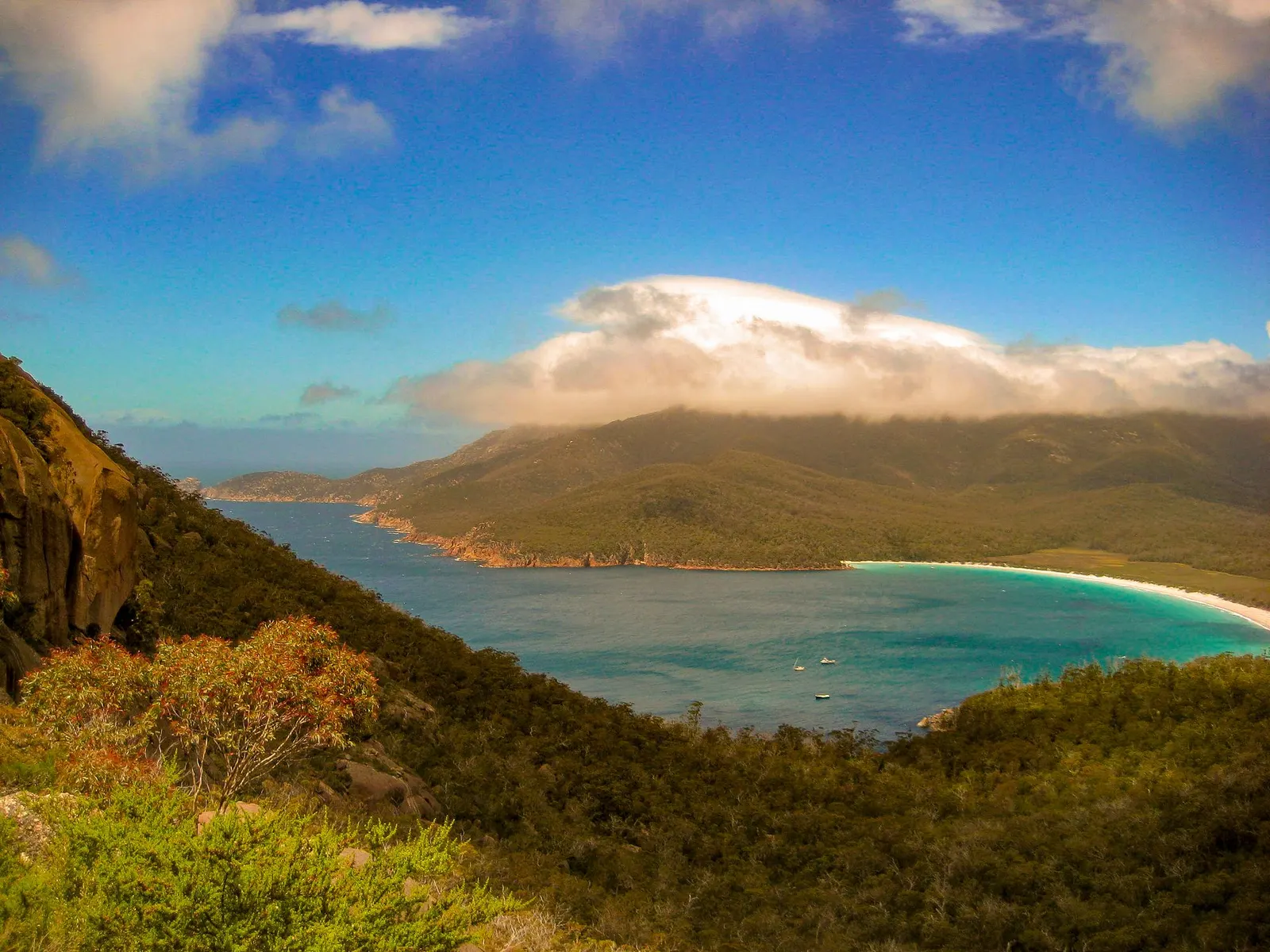
Honeymoon Bay camping in Freycinet National Park is a small, tent-only option on Tasmania’s east coast: seven individual sites, numbered 46 to 52 in the operator’s records, on a granite knoll above the bay. Parks and Wildlife Service Tasmania (PWS) groups them with Richardsons Beach and Ranger Creek, and they open for the shortest part of the year. This guide covers what the sites are like, how to reach them, what to do from camp and what to sort out before you go. It is written for any camper, whatever you arrive in.
What is Honeymoon Bay, and where does it sit?
The park covers much of the Freycinet Peninsula and Schouten Island, about 169 square kilometres. Pink-tinged Devonian granite, including the jagged Hazards range behind Coles Bay, shapes the coastline, and that same granite is what the camp sits on. The area was reserved in 1916, making it one of Tasmania’s oldest national parks. It lies in the traditional territory of the Oyster Bay nation, and shell middens and other significant Aboriginal sites are present, so visitors are asked to respect them. Later use included whaling, tin and coal mining and pastoral farming, and old mine shafts and whalers’ camp remains survive.
How do you get there, and what is the access like?
The park is roughly two and a half to three hours by road from Hobart or Launceston. Turn off the Tasman Highway onto Coles Bay Road, 12 kilometres south of Bicheno. The main entrance and visitor centre lie through Coles Bay township, 28 kilometres from the highway on a sealed road that suits any vehicle. Coles Bay is about 192 kilometres north-east of Hobart and 173 kilometres south-east of Launceston, with Bicheno 37 kilometres away and Swansea 43. A separate gravel road, about nine kilometres from the highway, leads to the Friendly Beaches section, which is a different part of the park.
The sites themselves are less straightforward. The operator’s data notes that sites 51 and 52 have steep driveways that can be slippery, and that some sites need four-wheel-drive access. The PWS page does not say which, so ask the visitor centre about your allocated number before bringing a low vehicle or a loaded trailer.
Can you camp at Honeymoon Bay, Tasmania, and can you camp on the beach?
Yes, you can camp at Honeymoon Bay, but only in tents, and only on the individual sites on the knoll. Caravans are not allowed. The sites overlook the bay rather than sitting on the sand, and the PWS describes the Richardsons Beach tent sites (19 to 45) as the ones marked out in the foredune vegetation. Camp where your booking places you. Honeymoon Bay allows up to six people per site.
Each pitch is separate, which suits small groups wanting some privacy. Electric barbecues, picnic tables and toilets are provided, but the PWS puts them about 100 metres from the sites, so carry cooking gear and take a torch at night. The operator’s record lists showers at nearby amenity blocks, a further walk away, and says pets are not permitted.
Online, summer and EasterBooking
Tents onlySites
YesToilets
ElectricBarbecues
Who this camp suits, and who should choose somewhere else
Honeymoon Bay suits tent campers happy to carry gear a short distance, who value a quieter elevated spot, and who can plan months ahead around the allocation process. It suits walkers, because the main tracks start within the park.
Look elsewhere if you:
- Travel with a camper trailer, rooftop tent or small campervan. The PWS lists powered sites at Richardsons Beach (1 to 18) for vehicle-based camping, and campervans up to 18 feet.
- Want showers and facilities beside your tent. Richardsons Beach has an amenities block with coin-operated hot showers and is close to the visitor centre.
- Want to camp outside the summer holidays and Easter. The PWS notes limited dune sites over winter.
- Travel with a pet. Dogs are not allowed at Honeymoon Bay on the operator’s record.
- Prefer to walk in. The PWS lists small walk-in tent sites at Wineglass Bay, Hazards Beach and Cooks Beach, with composting toilets. The PWS says no booking is needed and no camping charge applies, but water there is unreliable and no fires are allowed, so check the current notes with a ranger.
- Want something quieter on the coast. Friendly Beaches camping at Isaacs Point offers tent and campervan sites, and Ranger Creek is booked in the same category as Richardsons Beach.
What is there to do nearby?
Walking is the main reason to be here. The PWS lists:
- Cape Tourville circuit: 600 metres, about 20 minutes.
- Sleepy Bay: 500 metres return, about 20 minutes.
- Wineglass Bay Lookout: 2.6 kilometres return, 1 to 1.5 hours.
- Wineglass Bay beach: 6 kilometres return, 2.5 to 3.5 hours.
- Mount Amos: 3.6 kilometres return, about 3 hours, graded harder, with a panoramic view of Wineglass Bay.
- Wineglass Bay and Hazards Beach circuit: 11 kilometres, 4 to 5 hours.
- Freycinet Walk and Cycle Track: 4 kilometres one way, about an hour, the gentlest option.
- Hazards Beach: the walk notes describe about 7 kilometres of easy walking from the car park, around two hours.
The Freycinet Peninsula Circuit is a 27-kilometre, two to three day walk for those with overnight gear.
A one-night plan
Arrive, pitch, and fill water containers at the Honeymoon Bay taps. Spend the afternoon on a short walk such as the Cape Tourville circuit or Sleepy Bay, each about 20 minutes. Cook on an electric barbecue or a fuel stove. Next morning, walk to the Wineglass Bay Lookout (1 to 1.5 hours return) before packing up.
A weekend plan
Day one: arrive and pitch, then the Freycinet Walk and Cycle Track or a Sleepy Bay stroll. Day two: the Wineglass Bay beach walk (2.5 to 3.5 hours return) or Mount Amos (about 3 hours) in the morning, and an easy afternoon at camp. Day three: Cape Tourville on the way out, then lunch in Bicheno, which has a little penguin colony on Diamond Island with guided tours, a blowhole and cafes.
When is the best time to visit?
Honeymoon Bay opens only over the summer holidays and at Easter. Listings give the summer period as 18 December to 10 February, with a 10-night maximum stay in that window and 14 nights otherwise. Confirm both with the PWS.
These Bicheno monthly means come from Wikipedia’s climate table. They are for Bicheno, 37 kilometres from Coles Bay, so use them as a guide only.
| Season (Bicheno) | Mean daily maximum | Mean daily minimum |
|---|---|---|
| Summer (Dec to Feb) | about 20 to 22 degrees Celsius | about 12 to 13 |
| Autumn, includes Easter (Mar to May) | about 17 to 21 | about 8.5 to 12 |
| Winter (Jun to Aug) | about 14 to 15 | about 6 to 7 |
| Spring (Sep to Nov) | about 16 to 18.5 | about 7 to 10 |
Averages hide coastal wind and cool nights, so pack a range of layers. The park gets around 600 millimetres of rain a year and over 300 sunny days, according to Wikipedia.
How do you book Honeymoon Bay camping, and what does it cost?
Booking is the practical question. The Parks and Wildlife Service takes bookings online, and its page does not mention a ballot. Cancellation terms change from 3 November 2026, so read them when you book. Check parks.tas.gov.au for the current process.
On cost, camping fees vary and are set by the PWS, and a valid Tasmanian parks pass is also required to enter the park. Check current fees with the operator. Cancellation rules differ by date, so read them before paying.
Safety, fire and rules
- Fire: Freycinet is a fuel stove only area because it is very dry. Gas and fuel stoves are allowed except on Total Fire Ban days, when no naked flames are permitted. The electric barbecues can still be used then.
- Water: Drinking water is scarce. Refill at the visitor centre’s filtered station or the taps at Honeymoon Bay and the Wineglass Bay Walking Tracks car park. The operator lists camp water as untreated, so carry or treat drinking water.
- Rubbish: Take all of it out with you.
- Wildlife: Possums investigate food and unattended bags, so store food securely. Drive slowly and avoid night driving where possible.
- Drones are not permitted in Tasmanian national parks.
Wildlife and nature notes
Bennett’s wallabies are among the most commonly seen animals, alongside pademelons, echidnas and possums. Wikipedia also records eastern quolls, and notes that the Tasmanian devil has declined because of disease. Humpback whales pass in winter and seals rest on rocks. White-bellied sea-eagles and gannets can be seen from the Wineglass Bay and Cape Tourville lookouts. Wikipedia records over 500 plant species, including more than 80 orchids, in dry forest with black peppermint eucalypts over heath.
What should you bring?
- A tent suited to an exposed knoll, and a fuel stove.
- Plenty of drinking water and containers for refills.
- A head torch for the walk to the toilets.
- Secure food storage against possums.
- Layers and sun protection for the walks.
Planning checklist
- Confirm the booking process and dates with the PWS.
- Buy a valid Tasmanian parks pass.
- Ask which site number you have and whether it needs high clearance or four-wheel drive.
- Arrange pet care, because pets are not permitted.
- Pack a fuel stove and check for Total Fire Ban days.
- Plan your fuel and food stops in Coles Bay or Bicheno before you arrive.
Common mistakes
- Bringing a caravan. The sites are tent only.
- Counting on a campfire. None is allowed.
- Relying on camp water for drinking. It is untreated, and the park says water is scarce.
- Leaving food out. Possums go for it.
- Assuming the camp is open in winter. It is not.
- Leaving booking late. Check the PWS well ahead.
Supplies and services
The Freycinet Visitor Centre at the main entrance is open seven days, 9 am to 4 pm, phone 03 6256 7000. Coles Bay is the nearest township. Bicheno has cafes, craft shops and accommodation. The nearest dump point is at Bicheno or Swansea, and the camping areas have no laundry.
More from the operator: parks.tas.gov.au/explore-our-parks/freycinet-national-park/richardsons-beach-honeymoon-bay-and-ranger-creek-camping.
Plan it in the app
Save the camp on your route in MotoRidez and the planner shows road closures along the way, and where your tank runs out once you have entered the range of your vehicle. Save the route for offline use before you lose signal: it saves the corridor around your route, not a whole region.
Details come from the operator’s own records and pages, read on 20 October 2026, and change. We do not show prices or availability. Confirm fees, bookings, closures and fire rules with the operator before you go.
Questions riders ask
Can you camp at Honeymoon Bay, Tasmania?
Yes, in tents only, on individual sites 46 to 52 on a granite knoll in Freycinet National Park. The sites open only over the summer holidays and at Easter, and caravans are not allowed.
Can you camp on Honeymoon Bay beach?
The sites are on a granite knoll above the bay, not on the sand. Camp on the site your booking allocates, and check with the Freycinet Visitor Centre.
How to book Honeymoon Bay camping?
Book online through the Parks and Wildlife Service booking site. The official page does not mention a ballot. Check parks.tas.gov.au or call the Freycinet Visitor Centre on 03 6256 7000 for current availability.
How much does it cost to camp at Honeymoon Bay?
A tent site at Honeymoon Bay is $18.00 per site for up to six people, and a valid parks pass is needed on top.
Can I light a campfire at Freycinet?
Freycinet is a fuel stove only area. Gas and fuel stoves are allowed except on Total Fire Ban days, when only the electric barbecues can be used. Seasonal campfire bans started on 26 October 2026 in listed areas.
Is there drinking water at Honeymoon Bay?
There are taps, but the operator lists the water as untreated and the park says drinking water is scarce. Carry water and refill at the visitor centre.
How far is Freycinet National Park from Hobart?
The service gives about 2.5 to 3 hours by road from Hobart or Launceston. Coles Bay is about 192 kilometres north-east of Hobart.
Free, no subscription
Plan the curvy bits. Record the ride.
Watch your
map fill in.
Curvy routing, turn-by-turn voice navigation, ride recording and your ridden-roads map, with nothing behind a paywall.



Join the waitlist
Bring MotoRidez to your roads
The more riders register from your region, the sooner we get there. Put your name down, then send it to your ride group to move your region up the queue.
You're on the list ✓
Nice — you're in the queue
Every rider you bring moves your region up the list. Share it with your mates and your ride groups.